
OxNotes GCSE Revision
  • Home 🏡
  • AIC
  • GCSE/IGCSE
    • GCSE English Literature
    • IGCSE Physics
    • IGCSE Biology
    • IGCSE Chemistry
    • IGCSE Mathematics
    • GCSE Geography
    • GCSE Economics
    • GCSE History
    • MORE GCSE/IGCSE Subjects...
  • 🔎
  • Learn Faster 🔥

Home › GCSE/IGCSE Notes › Physics › Density and Pressure

The relationship between density, mass and volume can be expressed as the following formula:
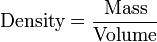
Density Formula
  • Mass is measured in grams.
  •  Volume is measured in cubic millilitres. 

Finding the density of an irregularly shaped solid

To find the density of an irregularly shaped solid we need to do practical work. The volume can be found out by measuring the volume of displaced liquid by an object. We can find the volume of these solids with the following steps:
  1. Weigh the object to find its mass as usual. 
  2. Find the object's volume.
Pouring water into two measuring cylinders is a method of finding the displacement. The reading must be taken at the lowest level of meniscus (the curved upper surface of a liquid) or curved surface of the liquid.
To find an object's volume, we need to do the following practical:
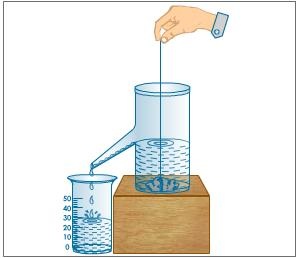
Displacement
Why ads?
Find your GCSE topic, and get great grades. Best of luck!
Help more students by tweeting #OxNotes
OxNotes, Free, Powerful GCSE Revision Notes. OxNotes: Exam, revision & homework help. GCSE/IGCSE secondary school study learning guides.
© Copyright 2017 OxNotes Education - All Rights Reserved. By using our site and service, you agree to our: "Privacy Policy, Cookie Policy & Disclaimer".
  • Home 🏡
  • AIC
  • GCSE/IGCSE
    • GCSE English Literature
    • IGCSE Physics
    • IGCSE Biology
    • IGCSE Chemistry
    • IGCSE Mathematics
    • GCSE Geography
    • GCSE Economics
    • GCSE History
    • MORE GCSE/IGCSE Subjects...
  • 🔎
  • Learn Faster 🔥